What is an Amperage?
Amperage is the amount of electric current flowing through a circuit, measured in amperes or amps. Amperage describes the rate of charge movement, while voltage provides the electrical pressure that drives current. A circuit's wire size, protective device, and connected equipment must support the expected amperage to operate safely.
Quick Facts About Amperage
Category
Electrical measurement
Formula
I = V ÷ R
Measured by
Ammeter or clamp meter
Common confusion
Amperage is not the same as voltage
Also called
Amps, Electric current
Often discussed with
Emergency Electrical Troubleshooting, Electrical Panel Upgrade
Key Takeaways About Amperage
- Amperage measures electric current, and the ampere is its standard unit.
- Higher amperage can require larger conductors and stronger overcurrent protection.
- Voltage pushes current, while resistance limits the amount that flows.
- A circuit breaker protects wiring from excessive amperage and overheating.
- Measured current should stay within the circuit's rated ampacity.
Understanding Amperage

Amperage is the amount of electric current moving through a conductor or circuit. Electricians measure it in amperes, commonly called amps. They represent amps with the letter A. Current consists of moving electric charge. An amp describes how fast charge passes a point in the circuit.
Related glossary terms: Ampacity, Current, Voltage.
Voltage and resistance affect amperage. Voltage creates electrical pressure that moves charge. Resistance limits that movement. A 120-volt circuit with a 12-ohm load draws 10 amps. This follows Ohm's law, written as I = V ÷ R. Actual current also depends on equipment condition and circuit design.
How Amperage Works, Is Measured, or Is Used?
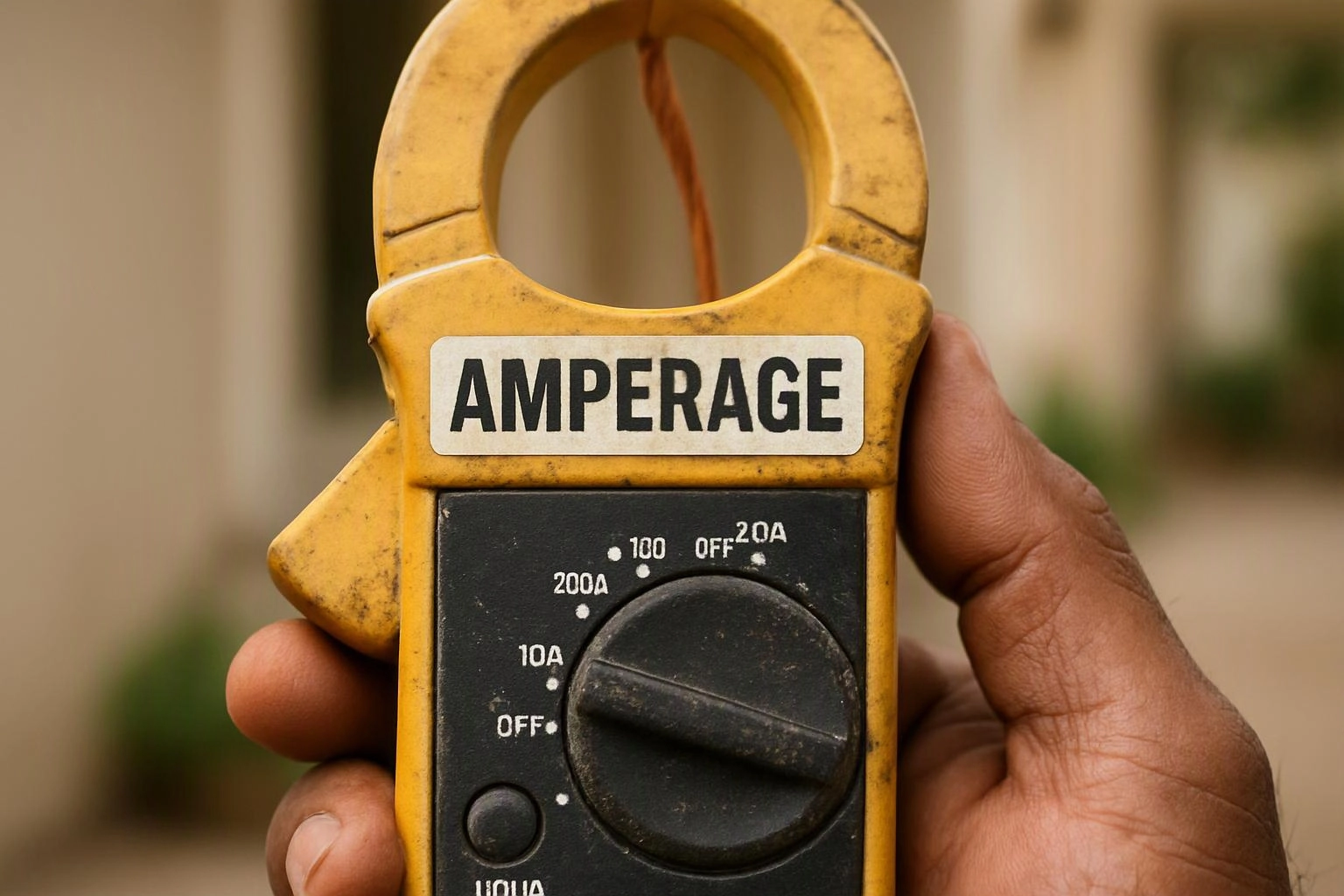
An ammeter measures current in amps. A clamp meter measures the magnetic field around one energized conductor. This lets a trained person check current without disconnecting the wire. A standard multimeter can measure current. It must connect in series and use the correct input port, range, and fuse.
Electricians compare measured amperage with the circuit's ampacity. Ampacity means the maximum current a conductor can carry under stated conditions. Wire material, conductor size, insulation rating, and air temperature affect ampacity. Installation method also affects it.circuit breaker or fuse provides overcurrent protection. It opens the circuit when current exceeds its permitted level long enough.
Equipment nameplates show expected current or a related rating. A motor may draw higher starting current than normal running current. A heating appliance often draws a steady load. A load calculation adds expected demand across circuits. It helps show if a branch circuit or electrical service can support new equipment.
Why Amperage Matters?

Excessive amperage creates heat in conductors, terminals, receptacles, and electrical equipment. Loose connections can create extra resistance. This creates local heating, even when circuit current seems normal. Persistent overheating can damage insulation and increase fire risk. You shouldn't install a larger breaker just to stop nuisance tripping.
Correct amperage supports reliable operation and protects equipment. A circuit may carry more current than its wiring or protective device allows. The system may then trip, overheat, or suffer voltage drop. A circuit may have more capacity than the equipment needs. That doesn't force extra current through the load. The load draws current according to its design.
When Amperage Matters Most?
Amperage matters during panel changes, appliance additions, electric vehicle charger installations, and troubleshooting. A new load may exceed an existing branch circuit's capacity. It may also exceed the service's available capacity. The decision should account for continuous loads and starting loads. It should also account for conductor and breaker ratings. The applicable electrical code also sets requirements.
Warning signs include repeated breaker trips, warm outlets, and discolored devices. Other signs include buzzing connections, flickering lights, and overheated plastic odors. A clamp-meter reading can help identify abnormal current. Testing energized equipment carries shock and arc-flash hazards. Santa Ana Electrician technicians may use amperage measurements during emergency troubleshooting. These measurements can separate an overloaded circuit from a failed device or damaged connection.
How to Evaluate Amperage?
- Compare measured current with the circuit breaker rating and the conductor's permitted ampacity.
- Check the equipment nameplate for rated amps, voltage, and any starting-current information.
- Measure each energized conductor separately with a properly rated clamp meter.
- Look for warm devices, discoloration, repeated trips, buzzing, or insulation damage.
- Confirm that continuous loads receive the required capacity under the applicable electrical code.
Related Concepts Compared
Amperage vs. Voltage
Voltage is electrical pressure, while amperage is the amount of current flowing. A circuit needs both suitable voltage and controlled amperage for proper operation.
Amperage vs. Ampacity
Amperage is the current actually flowing at a given moment. Ampacity is the maximum current a conductor can safely carry under specified installation conditions.
Amperage vs. Current
Current is the general electrical quantity describing charge flow. Amperage is the numerical measurement of that current in amperes.
Amperage vs. Wattage
Wattage measures electrical power. In a simple direct-current circuit, power equals voltage multiplied by amperage, written as P = V × I.
Expert Note
A breaker rating does not show the current a circuit always draws. It sets the protection limit. A lightly loaded 20-amp circuit may draw only 4 amps, while a faulty connection can overheat at a lower measured load because resistance is concentrated at one point.
Common Mistakes or Myths About Amperage
- Replacing a tripping breaker with a higher-rated breaker without checking conductor ampacity.
- Confusing a circuit's maximum rating with the current the connected load actually draws.
- Measuring current through both conductors together with a clamp meter, which can cancel the magnetic reading.
- Ignoring loose terminals because the measured amperage appears below the breaker rating.
Amperage in Practice: A Real-World Example
A 1,500-watt space heater on a 120-volt circuit draws about 12.5 amps. If other equipment raises the circuit demand near its permitted limit, the breaker may trip, and a qualified electrician should check the load and connections rather than install a larger breaker.
Sources & Further Reading on Amperage
Related Terms
Ampacity
Ampacity is the maximum current, measured in amperes, that a conductor can carry continuously under stated…
Current
Current is the movement of electric charge through a conductor, device, or circuit. Current is measured…
Voltage
Voltage is the electrical potential difference between two points. Measured in volts, voltage provides the pressure…
Overcurrent Protection
Overcurrent Protection is a safety function that stops or limits electrical current when it exceeds a…
Santa Ana Electrician
Have Questions About Amperage?
Contact Santa Ana Electrician for practical guidance on Amperage and related 24 hour electrician work in Santa Ana.