Skip to content
Glossary

What is a Voltage?

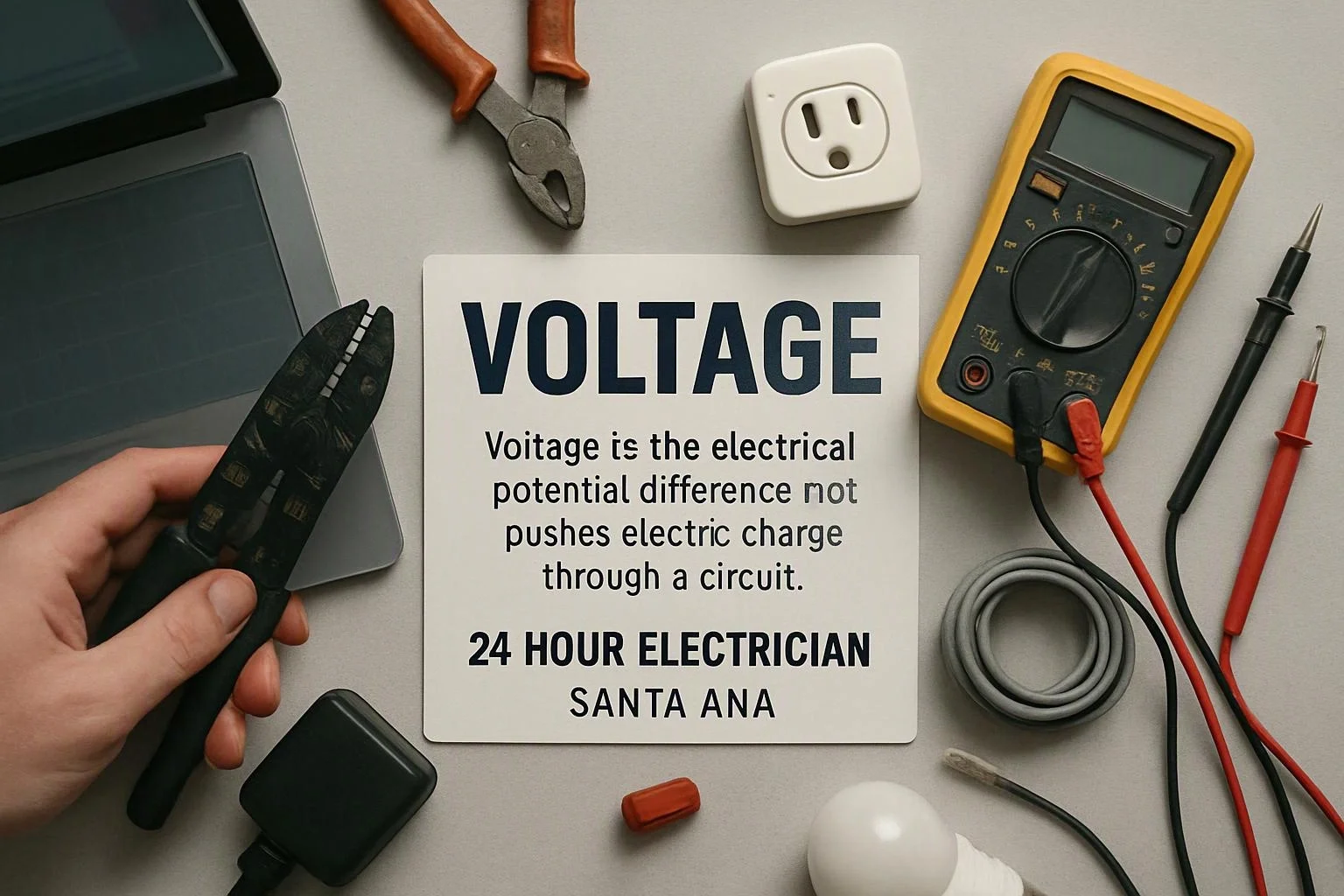
Voltage is the electrical potential difference between two points. Measured in volts, voltage provides the pressure that moves electric charge through a circuit. A source such as a battery, transformer, or utility system creates voltage. The amount present affects equipment operation, power delivery, insulation requirements, and the risk of electric shock.

Quick Facts About Voltage

Category

Electrical measurement

Formula

V = I × R

Measured by

Voltmeter or digital multimeter

Common benchmark

120 volts for many North American receptacles

Common confusion

Voltage is not the same as current or power

Also called

Electrical potential difference, Electric potential

Key Takeaways About Voltage

  • Voltage is measured in volts and exists between two points, not at one point alone.
  • Higher voltage can move the same power with less current through properly rated conductors.
  • A multimeter measures voltage across two points while the circuit remains energized.
  • Low or unstable voltage can cause poor equipment performance, overheating, or nuisance shutdowns.
  • Electrical shock risk depends on voltage, current path, contact time, and surrounding conditions.

Understanding Voltage

Santa Ana Electrician — detail view — Understanding Voltage

Voltage describes the difference in electrical potential between two points. It's measured in volts, represented by the letter V. This difference creates force that can move electric charge through a conductor. It works much like water pressure moving water through a pipe. Voltage has no useful meaning without a reference point. A measurement always compares one point with another.

Related glossary terms: Current, Amperage, Ohm.

A battery, utility transformer, generator, or electronic power supply can create voltage. In a home, the service system provides voltage to branch circuits, receptacles, lighting, and appliances. The listed voltage is a design value. It doesn't promise identical readings at every moment. Loads, wire length, loose connections, and utility conditions can cause small changes.

How Voltage Works, Is Measured, or Is Used?

The basic relationship between voltage, current, and resistance is Ohm's law, written as V = I × R. In this formula, V is voltage. I is current in amperes. R is resistance in ohms. A circuit with two volts across one ohm allows two amperes under steady conditions. Actual circuits may include inductance, capacitance, switching, and changing loads.

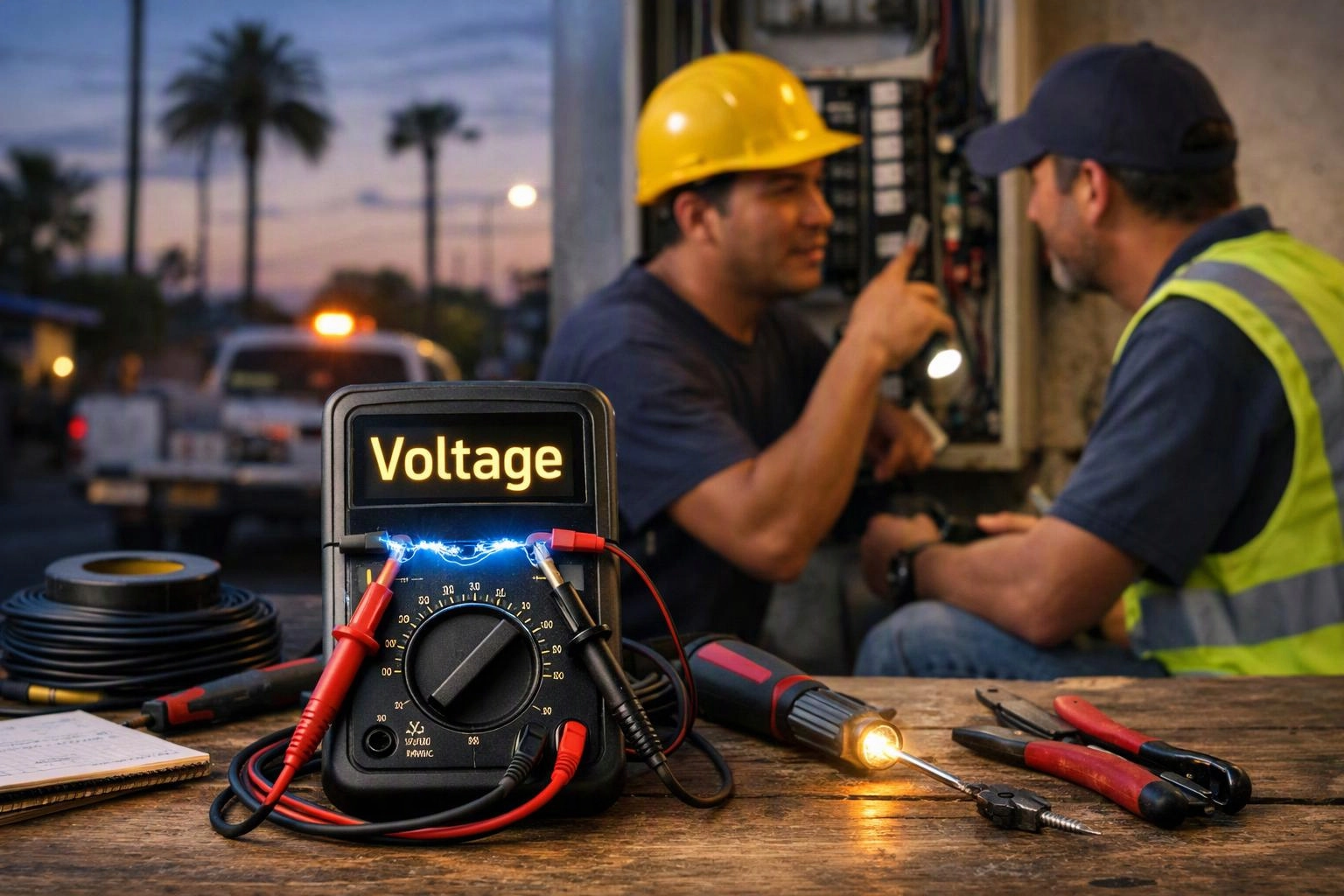
A digital multimeter measures voltage by connecting its test leads across two points. The meter connects in parallel, not in series. It compares the potential difference between two points. A technician selects AC voltage for utility power. They select DC voltage for batteries or many electronic systems. The meter, test leads, and measurement category must match the circuit. An incorrect setting or damaged lead can create an arc or shock hazard.

Common electrical systems use several voltage levels for different tasks. A standard North American receptacle commonly supplies about 120 volts. Many ranges, dryers, air-conditioning systems, and other large loads use about 240 volts. Control circuits may use 24 volts. Electronic equipment may convert incoming voltage to lower DC values. The correct voltage depends on the equipment nameplate, circuit design, and rules.

Why Voltage Matters?

Santa Ana Electrician — service highlight — Why Voltage Matters?

Voltage affects how equipment starts, runs, and delivers power. For a given power demand, higher voltage can reduce the needed current. This can reduce conductor losses when the circuit suits that voltage. A voltage drop develops when current travels through conductor resistance. This often happens across long runs or undersized wiring. Excessive drop can dim lights, reduce motor torque, trigger electronic faults, and produce heat at weak connections.

Voltage also affects safety. Contact with an energized part can drive current through the body. Damaged insulation or an incorrect rating can allow arcing. Overvoltage can damage parts. Undervoltage can make motors draw abnormal current or fail to start. Protective devices, grounding, insulation, and disconnects must suit the system voltage. They must also suit the connected equipment.

When Voltage Matters Most?

Voltage becomes important during new circuit installation, equipment replacement, troubleshooting, and power-quality checks. A nameplate may specify 120 volts, 208 volts, 230 volts, or 240 volts. These values aren't always interchangeable. Before connecting equipment, verify the supply voltage, phase arrangement, breaker rating, conductor size, and equipment instructions.

Useful checks include comparing line-to-neutral and line-to-line readings. Test voltage while the load operates. Look for changes when large equipment starts. A reading that's correct with no load may fall under load. This can happen if a connection is loose or a conductor is inadequate. Stop testing if insulation is damaged or conductors are exposed. Stop if testing requires opening energized equipment without proper training and protective equipment.

How to Evaluate Voltage?

  • Compare measured voltage with the equipment nameplate and the circuit design value.
  • Check line-to-neutral and line-to-line voltage where the system configuration requires both readings.
  • Measure under normal load to identify voltage drop that no-load testing may miss.
  • Inspect meter leads, meter category rating, and test settings before energized measurements.
  • Look for flickering lights, motor starting problems, heat, buzzing, or repeated electronic shutdowns.

Related Concepts Compared

Voltage vs. Current

Voltage is the electrical potential difference that drives charge.

Voltage vs. Amperage

Amperage is another name for current. Voltage and amperage work together, but they describe different electrical quantities.

Voltage vs. Wattage

Wattage measures electrical power. In a simple DC circuit, power equals voltage multiplied by current, written as P = V × I.

Voltage vs. Voltage Drop

Voltage drop is the reduction in voltage along a conductor or circuit component as current flows. It is one part of a circuit's voltage behavior, not a synonym for voltage.

Expert Note

A voltage reading can look normal with the circuit unloaded and still fall too far when a motor or heating appliance starts. Testing at the equipment while it operates often reveals connection or conductor problems that a panel reading misses.

Common Mistakes or Myths About Voltage

  • Assuming voltage exists at one point without identifying the reference point.
  • Confusing voltage with current, which can lead to incorrect wire or breaker decisions.
  • Using a meter on the wrong setting or with damaged test leads.
  • Treating 120 volts and 240 volts as interchangeable equipment supplies.
  • Checking voltage only with the circuit unloaded.

Voltage in Practice: A Real-World Example

A receptacle may measure 120 volts with no appliance connected. If the reading falls sharply when a vacuum starts, the circuit may have excessive voltage drop, a loose termination, or a supply problem. The cause requires testing at the panel and receptacle under load.

Related Terms

Current

Current is the movement of electric charge through a conductor, device, or circuit. Current is measured…

Amperage

Amperage is the amount of electric current flowing through a circuit, measured in amperes or amps…

Ohm

Ohm is the SI unit of electrical resistance, written with the symbol Ω. One ohm of…

Phase

Phase is the position of an alternating-current waveform within its repeating cycle, measured as an angle…

Santa Ana Electrician

Have Questions About Voltage?

Contact Santa Ana Electrician for practical guidance on Voltage and related 24 hour electrician work in Santa Ana.

+1 (949) 850-2844