What is a Busbar?
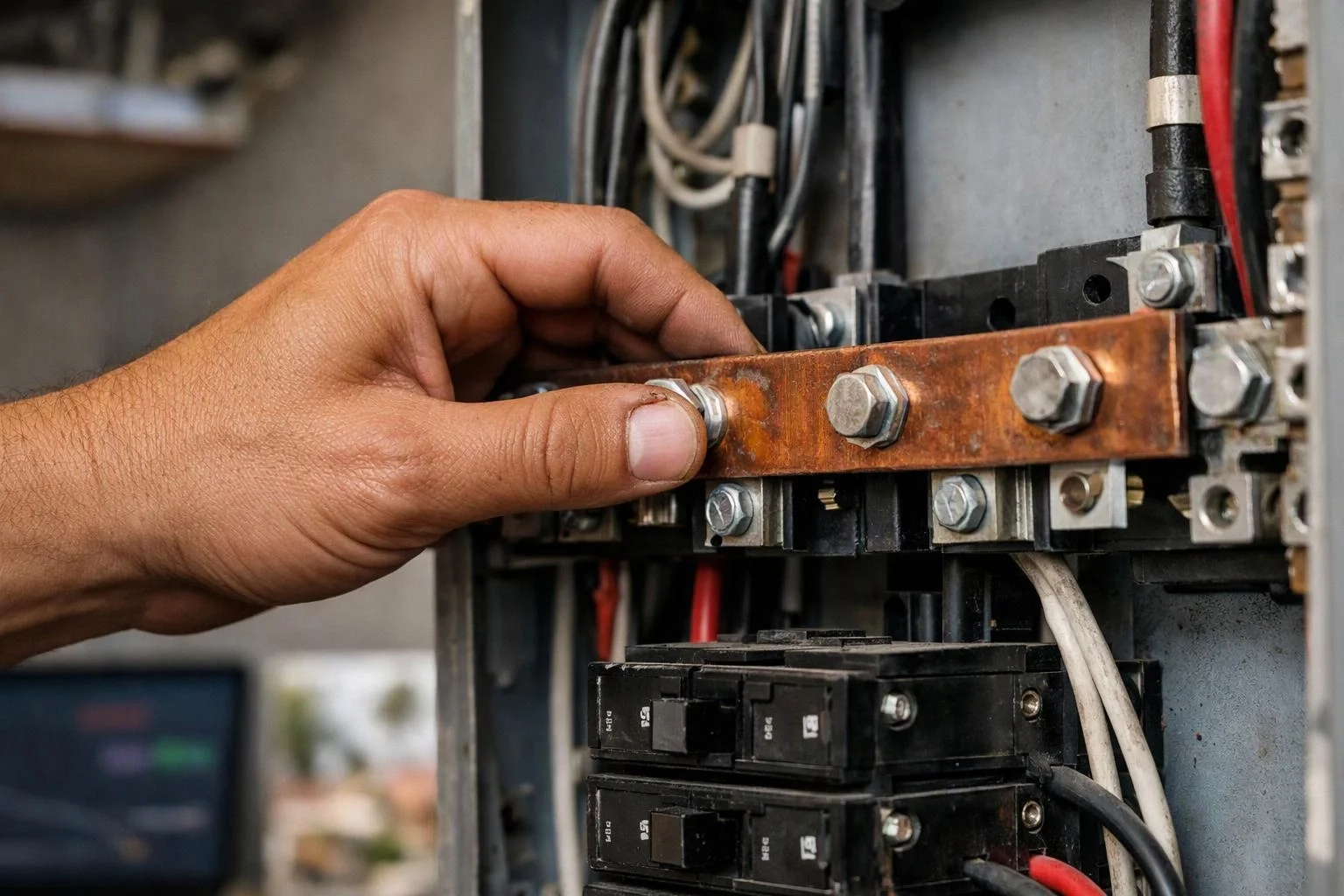
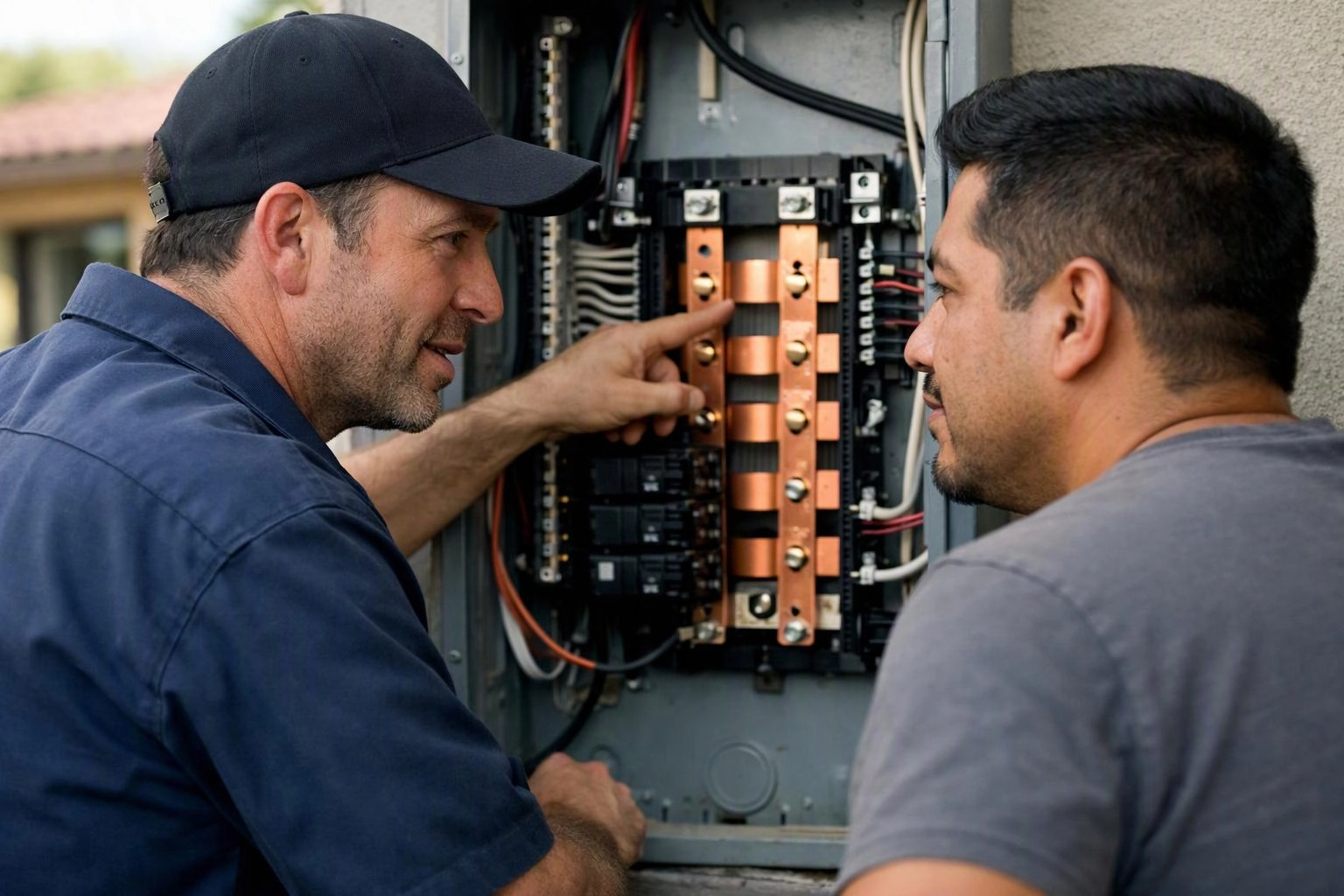
Busbar is a rigid conductor made from copper or aluminum that distributes electrical power within a panelboard, switchboard, switchgear assembly, or other equipment. Busbars may be bare or insulated and usually have a rectangular, tubular, or solid form. Their size, material, spacing, and temperature rating determine safe current capacity.
Quick Facts About Busbar
Category
Power distribution conductor
Used for
Distributing current inside electrical equipment
Common confusion
A busbar is not automatically a neutral or grounding bar
Also called
Bus bar, Electrical bus
Often discussed with
Electrical Panel Repair, Electrical Panel Upgrade
Key Takeaways About Busbar
- Busbars move electrical current between feeders, breakers, and connected equipment.
- Copper and aluminum are the most common busbar materials.
- Ampacity depends on material, cross-sectional area, temperature, enclosure, and installation conditions.
- Insulation, spacing, and barriers help prevent contact, arcing, and short circuits.
- A busbar is not the same as a neutral conductor or grounding conductor.
Understanding Busbar

Busbar means a solid electrical conductor. It carries and shares power inside equipment. Unlike a flexible cable, a busbar usually has a fixed shape. It follows a planned path through a panelboard, switchboard, or switchgear assembly. Copper and aluminum are standard materials. Both conduct electricity well and carry high current in small spaces.
Related glossary terms: Ampacity, Current, Overcurrent Protection.
A busbar may connect one main conductor to several circuit breakers. It may also link equipment sections using the same voltage. Some busbars sit exposed inside restricted electrical enclosures. Others have insulation, heat-shrink covers, or molded barriers. A neutral bar and grounding bar are special busbars. Their functions and connection rules differ.
How Busbar Works, Is Measured, or Is Used?
Electrical current enters a busbar from a supply conductor. It leaves through connected branch circuits or feeders. The metal provides a low-resistance path. This reduces voltage drop compared with several long conductors. Those conductors would serve the same distribution point. Breakers or other overcurrent devices attach to the busbar. Approved clips, bolts, links, or other hardware make these connections.
Engineers select a busbar by checking ampacity (current-carrying capacity). They also check voltage rating and temperature limits. They check short-circuit withstand rating and physical size. Ampacity depends on the metal type and cross-sectional area. It also depends on the enclosure and surrounding temperature. Heat transfer also affects ampacity. A wider or thicker bar often carries more current. However, size alone doesn't prove safety. The complete assembly must be tested and listed for its use.
Installation also requires correct spacing and secure joints. A technician checks torque at bolted connections. The technician confirms that contact surfaces are clean. The technician follows the equipment manufacturer's instructions. In a three-phase system, separate bars may serve each phase. An insulated neutral bar serves a different role. A bonded grounding bar serves another electrical role.
Why Busbar Matters?

Busbars affect the capacity, trust, and ease of service. They affect electrical distribution equipment. A well-chosen busbar can fit several circuits inside one small enclosure. It can also make breaker replacement more orderly. Circuit expansion becomes more orderly too. Its low-resistance path helps limit extra heating. It also helps limit voltage loss during normal use.
A loose joint, damaged insulation, or wrong breaker connection can create a hot spot. An undersized bar can also create a hot spot. Heat may discolor metal or damage insulation. It may weaken nearby parts or cause an electrical fault. A short circuit can create very high current. It can also create strong mechanical forces. The assembly needs suitable overcurrent protection. It also needs clearances, barriers, and a checked short-circuit rating.
When Busbar Matters Most?
Busbar design becomes very important during a panel upgrade. It also matters during a service change or commercial installation. Equipment replacement also requires careful busbar design. A new breaker must match the panel's busbar design and listing. It must not merely fit the open space. Adding circuits without checking load calculations can create problems. Workers must also check spaces, heat, and available fault current. These issues can create safety and compliance problems.
Inspection also matters after signs of overheating or arcing appear. Look for darkened metal or melted insulation. Check for a burnt odor, pitting, or loose hardware. Watch for unusual buzzing or repeated breaker trips. Workers must de-energize equipment before internal work. They must test that no voltage remains. Energized work may need extra controls. Applicable electrical safety rules may require these controls.
How to Evaluate Busbar?
- Confirm the busbar's material, dimensions, voltage rating, and ampacity from the equipment label or manufacturer documentation.
- Check that the busbar assembly has a suitable short-circuit current rating for the available fault current.
- Inspect joints for discoloration, pitting, melted insulation, loose hardware, or signs of overheating.
- Verify that breakers and accessories are listed or approved for that specific panelboard or switchgear.
- Check torque values against the manufacturer's instructions and record completed torque checks.
Related Concepts Compared
Busbar vs. Wire
A wire is usually a flexible conductor with insulation around one or more strands. A busbar is usually rigid and shaped for organized power distribution inside equipment.
Busbar vs. Neutral Bar
A neutral bar carries grounded circuit conductors and may connect to the service neutral under specific bonding rules. A general busbar can distribute phase power and does not automatically serve as a neutral bar.
Busbar vs. Grounding Bar
A grounding bar connects equipment grounding conductors and bonds exposed metal parts as required. A power busbar carries normal circuit current, while a grounding bar normally carries current only during a fault.
Busbar vs. Busway
Busway is a complete enclosed distribution system that contains busbars, insulation, housing, and connection points. A busbar is the conductor itself and may be installed inside many types of equipment.
Expert Note
A busbar's physical size does not establish its permitted ampacity by itself. The enclosure, temperature rise, joint design, spacing, listed assembly, and available fault current must all match the manufacturer's data and applicable electrical requirements.
Common Mistakes or Myths About Busbar
- Assuming any breaker that physically fits is approved for the busbar.
- Treating the neutral bar and grounding bar as interchangeable in every panel.
- Adding circuits without checking busbar capacity, panel rating, and the calculated load.
- Ignoring discoloration or a burnt odor around busbar joints.
- Touching or tightening a busbar before proving that the equipment is de-energized.
Busbar in Practice: A Real-World Example
A 200-amp panel may use a copper busbar to feed many branch-circuit breakers. An unapproved breaker may fit, but its bus connection may stay unsafe or noncompliant.
Sources & Further Reading on Busbar
Related Services
Related Terms
Ampacity
Ampacity is the maximum current, measured in amperes, that a conductor can carry continuously under stated…
Current
Current is the movement of electric charge through a conductor, device, or circuit. Current is measured…
Overcurrent Protection
Overcurrent Protection is a safety function that stops or limits electrical current when it exceeds a…
Electrical Grounding
Electrical Grounding is a safety system that connects electrical equipment and circuits to earth or a…
Santa Ana Electrician
Have Questions About Busbar?
Contact Santa Ana Electrician for practical guidance on Busbar and related 24 hour electrician work in Santa Ana.