Skip to content
Glossary

What is Neutral Wire?

Neutral Wire is a current-carrying conductor that normally returns electricity from a load to the service panel in a single-phase circuit. It connects to the grounded conductor at the service disconnect and usually carries near-zero voltage to ground. Neutral wires commonly use white or gray insulation. But color alone can't prove safe identification.

Quick Facts About Neutral Wire

Category

Electrical conductor

Used for

Returning current from loads

Common benchmark

White or gray insulation

Common confusion

Neutral is not the same as ground

Also called

Grounded conductor, Neutral conductor

Often discussed with

Emergency Electrical Troubleshooting, Electrical Wiring Repair

Key Takeaways About Neutral Wire

  • A neutral wire normally carries current back to the service panel after power passes through a load.
  • White or gray insulation commonly identifies neutral conductors. But testing remains necessary before work.
  • Neutral and ground connect at the service disconnect, not at ordinary downstream panels or outlets.
  • A loose neutral can create unstable voltages, flickering lights, equipment damage, or shock hazards.
  • Multiwire branch circuits require correct neutral connections and shared overcurrent protection.

Understanding Neutral Wire

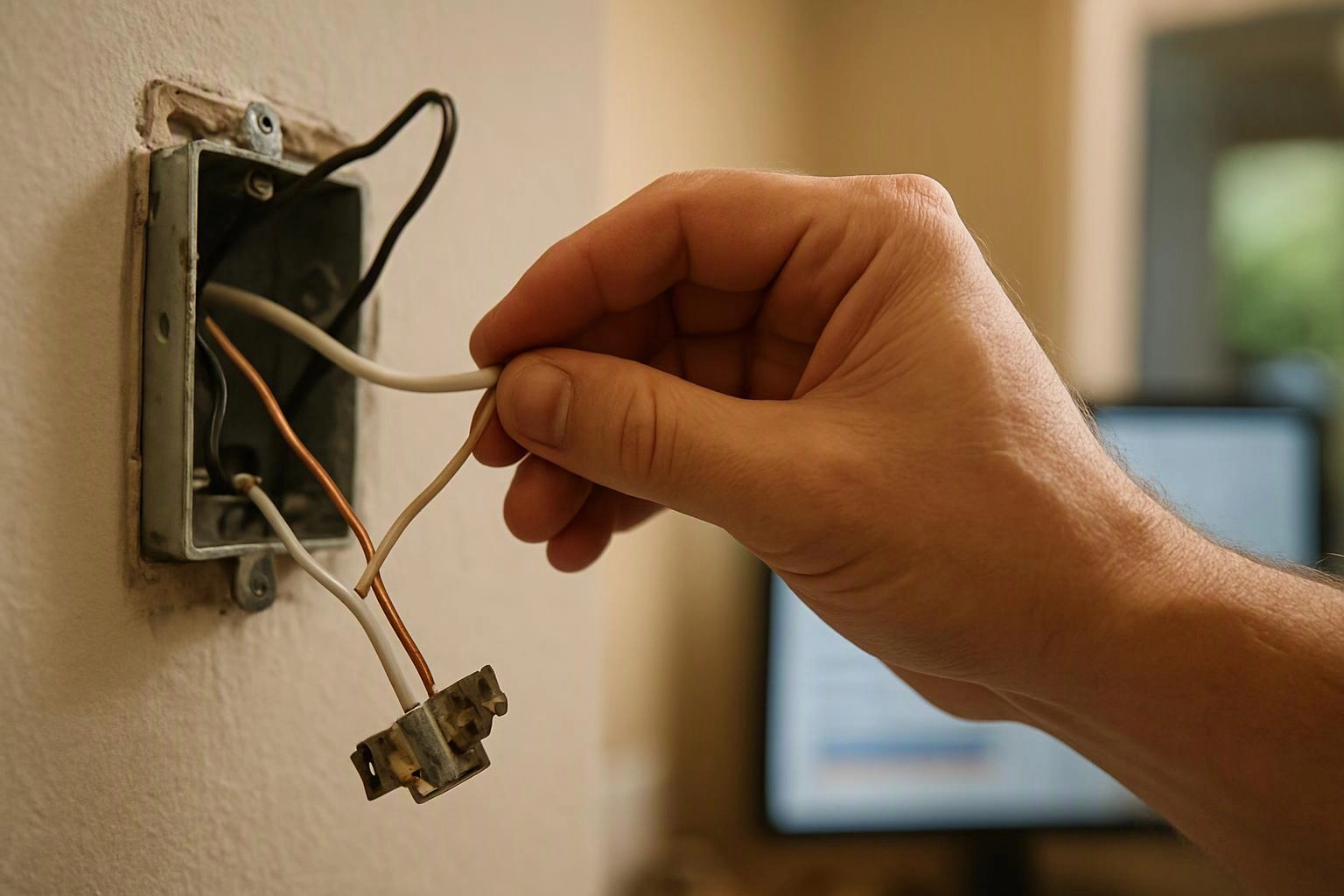
Santa Ana Electrician — detail view — Understanding Neutral Wire

Neutral wire is the grounded circuit conductor. It normally carries current from an electrical load toward the service panel. A typical 120-volt branch circuit uses a hot conductor. It delivers energy to a light, receptacle, or appliance. The neutral completes the circuit. The neutral connects to the grounded conductor terminal at the service disconnect.

Related glossary terms: Alternating Current, Branch Circuit, Electrical Grounding.

Neutral wires commonly have white or gray insulation under electrical wiring rules. Yet insulation color doesn't replace testing. A neutral can carry current whenever a connected load operates. The conductor may measure close to zero volts to ground normally. An open or overloaded neutral can produce dangerous voltage changes.

How Neutral Wire Works, Is Measured, or Is Used?

Electric current flows through a complete path. In a basic 120-volt circuit, current travels from the energized hot conductor. It passes through the load and returns on the neutral. The circuit's current depends on the load and voltage. Ohm's law describes this relationship. I = V/R. I means current, V means voltage, and R means resistance.

An electrician identifies a neutral by tracing conductors and checking terminations. They measure voltage with an approved voltage tester or multimeter. A normal measurement between hot and neutral is near the circuit's rated voltage. Neutral-to-ground voltage is often low under a modest load. Readings alone don't prove that a conductor is safe. Wiring faults can place voltage on a supposed neutral.

Some circuits share one neutral between two hot conductors. This arrangement is called.multiwire branch circuit. The shared neutral must remain continuous. The associated hot conductors need the correct disconnecting setup. They also need the correct overcurrent protection arrangement. Removing or loosening that neutral can place excessive voltage across connected equipment.

Why Neutral Wire Matters?

Santa Ana Electrician — service highlight — Why Neutral Wire Matters?

A sound neutral supports stable voltage and normal equipment operation. A loose connection may cause lights to brighten or dim. It may cause electronics to reset and motors to run poorly. In a 120/240-volt system, a failed service neutral can cause unequal voltage. This can affect separate 120-volt loads and damage appliances.

Neutral conductors also affect shock protection and code compliance. The neutral is grounded at the service disconnect. Downstream equipment grounding conductors follow a separate path. Bonding neutral and ground together in the wrong panel can send normal current onto metal paths. These paths include enclosures and grounding conductors.

When Neutral Wire Matters Most?

Neutral wiring deserves close attention during panel changes and outlet replacements. It also matters during generator connections and flickering-light troubleshooting. Older wiring, aluminum conductors, and shared-neutral circuits need special care. Signs of heat at a terminal also need attention. A qualified inspection should check conductor size and insulation condition. It should check terminal torque and the neutral-to-ground bond's panel location.

Turn off the circuit before opening an outlet, switch box, or panel. Verify that power is absent with a properly rated tester. Don't assume that a white wire is de-energized. This matters especially in switch loops or modified wiring. A neutral problem can remain hidden until several loads operate together. Testing under load may reveal problems that a visual check misses.

How to Evaluate Neutral Wire?

  • Check whether the neutral conductor matches the circuit ampacity and wiring method.
  • Measure hot-to-neutral and neutral-to-ground voltage with a properly rated meter.
  • Inspect neutral terminals for looseness, discoloration, corrosion, or heat damage.
  • Confirm that neutral and ground are bonded only at the service disconnect.
  • Ask whether a shared neutral has continuous connections and correct breaker protection.

Related Concepts Compared

Neutral Wire vs. Grounding Conductor

A grounding conductor normally carries fault current only during a problem. A neutral normally carries operating current as part of the circuit.

Neutral Wire vs. Ground Wire

Ground wire is a common name for an equipment grounding conductor. It bonds exposed metal parts to a fault-clearing path and does not replace a neutral.

Neutral Wire vs. Hot Wire

A hot wire normally supplies voltage from the panel to a load. A neutral normally provides the return path from the load.

Neutral Wire vs. Grounded Conductor

Grounded conductor is the technical code term commonly used for a neutral conductor. Grounded does not mean that the conductor carries no current.

Expert Note

A neutral terminal can look tight while failing electrically because oxidation, poor torque, or a damaged conductor reduces contact quality. Voltage checks under load and inspection of the termination often reveal problems that a simple continuity test misses.

Common Mistakes or Myths About Neutral Wire

  • Treating a neutral as harmless because its insulation is white.
  • Connecting neutral and ground together in a downstream panel.
  • Using the equipment grounding conductor instead of installing a required neutral.
  • Leaving a shared neutral loose or disconnected during outlet work.
  • Failing to test for backfeed from another circuit or source.

Neutral Wire in Practice: A Real-World Example

A kitchen circuit has a hot wire, neutral wire, and equipment grounding conductor. Current flows through the refrigerator on the hot and returns on the neutral. If the neutral terminal loosens, the refrigerator may reset while lights on the same circuit flicker.

Related Terms

Alternating Current

Alternating Current is electric current that repeatedly changes direction and varies in magnitude over time. Most…

Branch Circuit

Branch Circuit is the wiring between the final overcurrent device, such as a circuit breaker, and…

Electrical Grounding

Electrical Grounding is a safety system that connects electrical equipment and circuits to earth or a…

National Electrical Code

National Electrical Code is a safety standard published by the National Fire Protection Association that sets…

Santa Ana Electrician

Have Questions About Neutral Wire?

Contact Santa Ana Electrician for practical guidance on Neutral Wire and related 24 hour electrician work in Santa Ana.

+1 (949) 850-2844