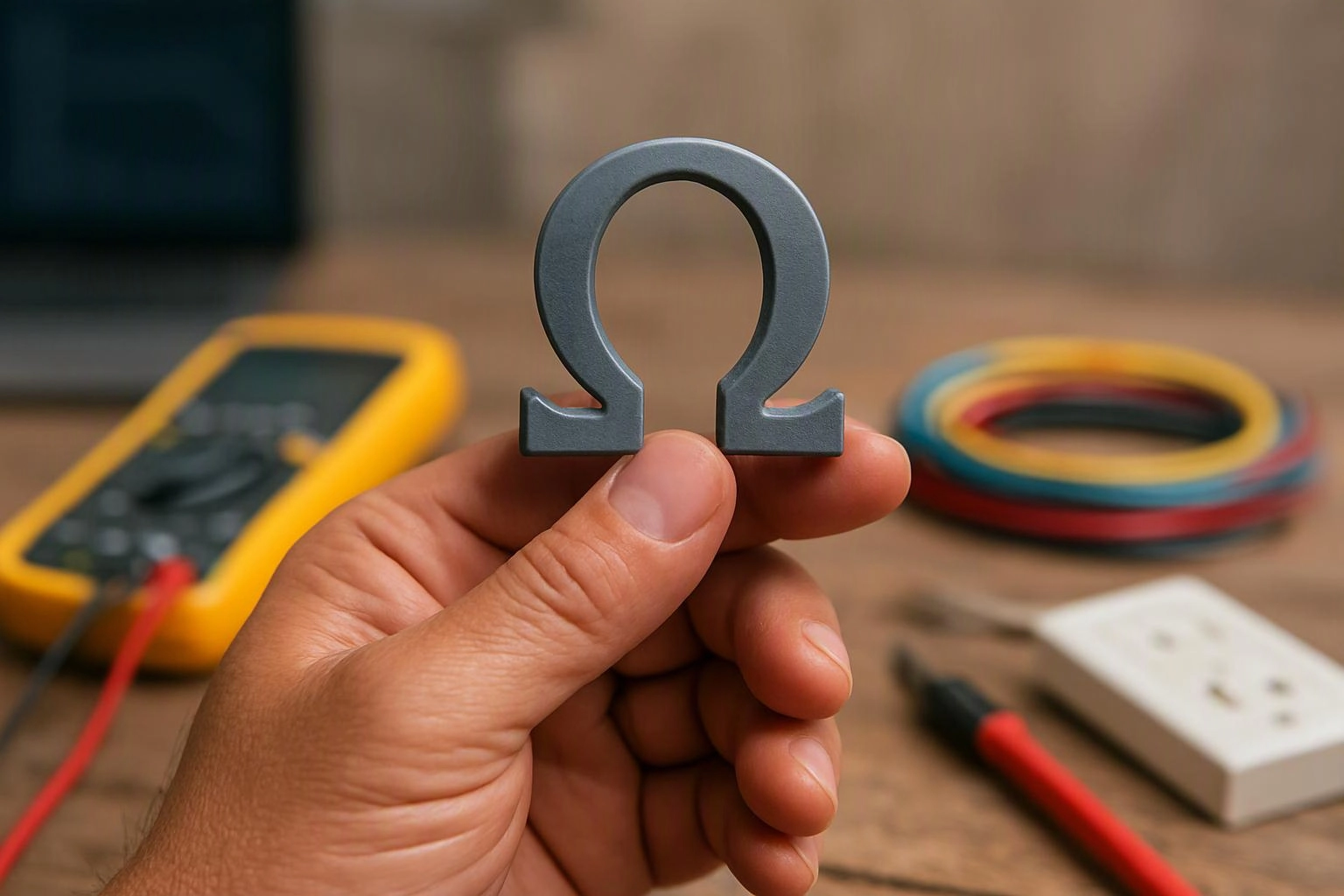
What is an Ohm?
Ohm is the SI unit of electrical resistance, written with the symbol Ω. One ohm of resistance allows one ampere of current to flow when one volt is applied. The unit describes how strongly a material or device opposes current, helping electricians select conductors, test circuits, and identify abnormal resistance.
Quick Facts About Ohm
Category
SI unit of electrical resistance
Formula
R = V ÷ I
Measured by
Ohmmeter or digital multimeter
Common confusion
Ohm measures resistance, not current or voltage
Also called
Ω, Unit of resistance
Often discussed with
Emergency Electrical Troubleshooting, Electrical Wiring Repair
Key Takeaways About Ohm
- Resistance is measured in ohms, represented by the Greek letter omega, Ω.
- One volt across one ohm produces one ampere of current.
- Higher resistance usually permits less current at the same voltage.
- A multimeter measures resistance only on a de-energized circuit.
- Loose connections, damaged conductors, and failed components can change resistance.
Understanding Ohm

Ohm is the standard unit of electrical resistance in the International System of Units. Resistance describes how much a material or device opposes electric charge movement. The unit symbol is Ω. It's the Greek letter omega. A resistor, heating element, light bulb filament, or wire may have measurable resistance.
Related glossary terms: Current, Voltage, Amperage.
The relationship between voltage, current, and resistance follows Ohm's law. One ohm exists when one volt produces one ampere through a component. Materials with low resistance let current pass more easily. Materials with high resistance restrict current. They often change more electrical energy into heat.
How Ohm Works, Is Measured, or Is Used?
Electricians calculate resistance with the formula R = V ÷ I. In this formula, R represents resistance in ohms. V represents voltage in volts. I represents current in amperes. The same relationship can find voltage or current. Known resistance helps predict circuit behavior before equipment is connected.
A digital multimeter measures resistance with a small test current. It sends this current through the component. Then, it reads the resulting voltage. Turn off power and isolate the component before testing. An energized circuit can damage the meter or cause a false reading. Touching both probes across a resistor gives a direct reading. Touching the probes together shows the meter's low-resistance baseline.
Wire resistance depends on conductor length, cross-sectional area, material, and temperature. A longer copper conductor has more resistance than a shorter conductor of the same size. A smaller conductor also has more resistance. This can create unwanted voltage drop and heat. These effects grow when the circuit carries substantial current.
Why Ohm Matters?

Resistance affects current flow, equipment performance, heat, and voltage at the load. If resistance rises unexpectedly in a connection, the circuit may deliver less voltage. This can affect a motor, light, or appliance. The connection can also heat up when current passes through a small contact area. This risk grows if the connection is loose or damaged.
Resistance testing helps separate normal circuit behavior from a fault. A near-zero reading across a path that should be open may indicate.short circuit. A very high or infinite reading across a conductor may indicate a break. This applies when the conductor should be continuous. The correct expected value depends on the component and circuit design.
When Ohm Matters Most?
Ohms matter during electrical troubleshooting, equipment testing, and circuit design. Technicians compare measured values with manufacturer specifications or wiring diagrams. They also compare them with calculated results. A small resistance in a long branch circuit may be normal. An unexpected increase at a terminal can point to corrosion, a loose splice, or a damaged conductor.
Resistance also matters when choosing wire size, checking heating devices, and testing motor windings. The test must match the component. Some electronic devices contain capacitors or control circuits. These parts can affect the reading. For safety, power must be disconnected. Stored energy must be released. The circuit must be verified before an ohmmeter is connected.
How to Evaluate Ohm?
- Confirm that the meter displays Ω and that the circuit is de-energized before measuring resistance.
- Compare the measured value with the component manufacturer's specified resistance or tolerance.
- Check for near-zero resistance across paths that should remain electrically separate.
- Inspect high-resistance connections for heat damage, corrosion, looseness, or conductor damage.
- Account for test-lead resistance when measuring values below one ohm.
Related Concepts Compared
Ohm vs. Resistance
Resistance is the physical property that opposes current. Ohm is the unit used to express the amount of resistance.
Ohm vs. Voltage
Voltage is the electrical potential difference that pushes charge through a circuit. Ohm measures the circuit's opposition to that movement.
Ohm vs. Amperage
Amperage describes the amount of current flowing through a circuit. Ohm describes resistance, which helps determine how much current flows at a given voltage.
Ohm vs. Ohm's Law
Ohm's law is the relationship among voltage, current, and resistance. Ohm is only the measurement unit for resistance within that relationship.
Expert Note
A resistance reading is meaningful only when you know what the circuit should contain. Parallel paths can produce a lower reading than the individual component, and capacitors can cause readings to change while they charge from the meter.
Common Mistakes or Myths About Ohm
- Measuring resistance on an energized circuit can damage the meter and create a safety hazard.
- Assuming every near-zero reading indicates a short ignores normal continuity through conductors and closed switches.
- Ignoring test-lead resistance can distort measurements below one ohm.
- Treating resistance, voltage, and current as interchangeable leads to incorrect diagnosis.
- Replacing a component without checking the expected resistance can hide the original fault.
Ohm in Practice: A Real-World Example
A 120-volt heating element draws 10 amperes when its resistance is 12 ohms. If a damaged connection adds resistance at one terminal, the element may receive less voltage while the connection produces excess heat.
Sources & Further Reading on Ohm
- National Institute of Standards and Technology, SI Units
- Bureau International des Poids et Mesures, SI Units
Related Terms
Current
Current is the movement of electric charge through a conductor, device, or circuit. Current is measured…
Voltage
Voltage is the electrical potential difference between two points. Measured in volts, voltage provides the pressure…
Amperage
Amperage is the amount of electric current flowing through a circuit, measured in amperes or amps…
Short Circuit
Short Circuit is an unintended low-resistance path that allows excessive electrical current to flow between conductors…
Santa Ana Electrician
Have Questions About Ohm?
Contact Santa Ana Electrician for practical guidance on Ohm and related 24 hour electrician work in Santa Ana.