
What Is Continuity?
Continuity is an unbroken electrical path that allows current to travel between connected points. Electricians check continuity to identify open circuits, loose connections, broken conductors, or incomplete paths. A continuity test normally uses a meter while power is off, helping confirm whether wiring, protective devices, and circuit parts connect as intended.
Quick Facts About Continuity
Category
Electrical testing concept
Used for
Finding open or incomplete circuits
Common confusion
A continuous path may still have incorrect voltage
Also called
Electrical continuity, Continuity test
Often discussed with
Electrical Safety Inspection
Key Takeaways About Continuity
- Continuity describes a complete path, not the amount of current flowing.
- Testing usually requires de-energized wiring and a suitable meter.
- Continuity does not prove correct voltage, polarity, or circuit operation.
How Continuity Works
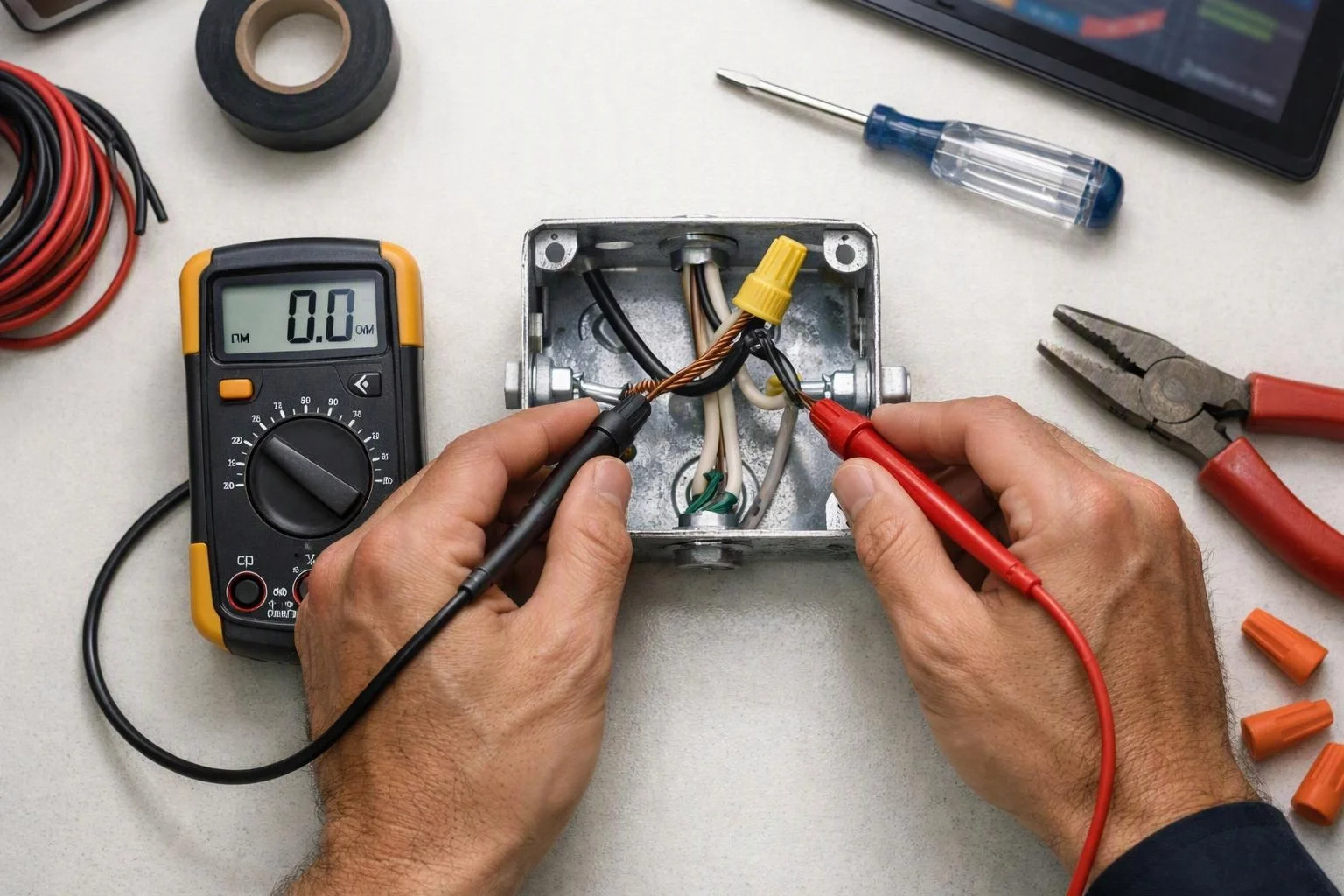
Continuity testing checks whether an electrical path connects selected points without an open section. A meter sends a small test signal through the path and indicates whether the circuit is complete. The result helps an electrician trace wiring, inspect connections, and locate a break in a conductor.
Related glossary terms: Conductor, Ohm, Polarity.
A continuity result has a practical limit. A complete path does not confirm that the circuit has the correct voltage, polarity, capacity, or grounding. For an electrical safety inspection, the test may cover conductors, switches, receptacles, and protective devices. The electrician isolates the circuit before testing, then interprets the result with visual inspection and other meter checks.
From the Santa Ana Electrician team
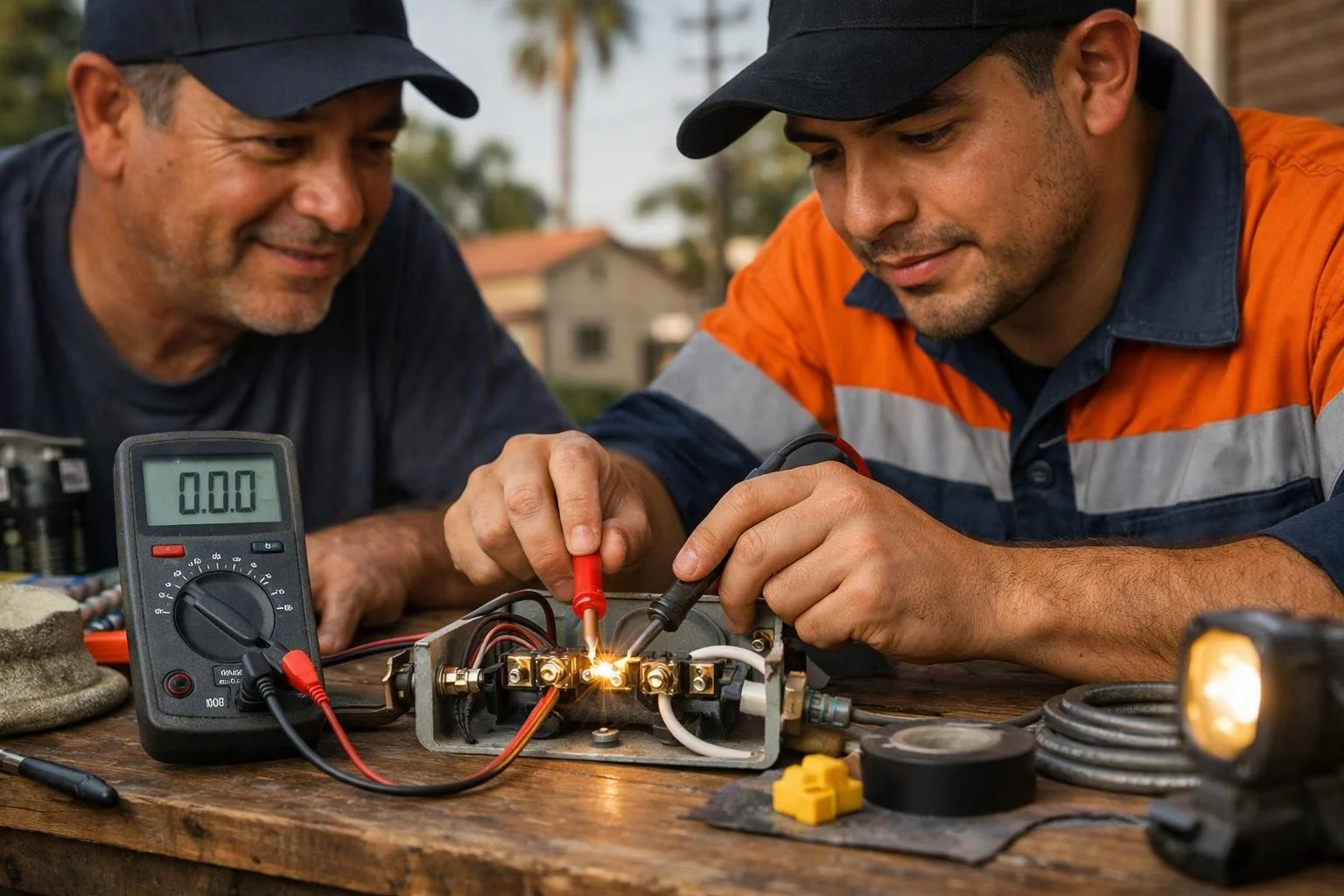
When we check continuity during an Electrical Safety Inspection, we isolate the circuit and test the relevant conductors or components with a meter. We compare the reading with visual findings, connection quality, and the circuit’s intended path. A complete reading does not replace voltage, polarity, or grounding checks.
Continuity in Practice: A Real-World Example
During an Electrical Safety Inspection, an electrician tests a conductor between an electrical box and a receptacle. The meter shows an open path, which directs the inspection toward a broken wire, loose terminal, or disconnected splice.
Related Services
Related Terms
Conductor
A conductor is a material or component that allows electric charge to move through a circuit…
Ohm
An ohm is the unit used to express electrical resistance, which describes how strongly a material…
Polarity
Polarity is the correct relationship between the energized, neutral, and grounding conductors in an electrical circuit…
Neutral Wire
A Neutral Wire is a current-carrying conductor that normally completes the electrical path from a load…
Santa Ana Electrician
Have Questions About Continuity?
Contact Santa Ana Electrician for practical guidance on Continuity and related 24 hour electrician work in Santa Ana.